
GANDHARVAN
On love, longing, and the truths we escape into

In a hundred worlds, in worlds parallel to other worlds that might be walking beside ours in some other space and time, I could have been a celestial god in one. All of us. We might have been angels opening the world wide to desire, and we might have been the world itself in all heavens, and the heavens in all worlds. And when it feels as if the clouds are carrying us to different worlds, through wormholes with tiaras and crowns, in one of those worlds I am a gandharvan — the same angel my mother warned me not to speak of. And for the journey of that world into this one, I am almost dead now. I am in the clouds being carried toward different worlds to choose from.
To leave the world, to make that decision one fine morning, was not easy for me. I returned from my walk in the morning. I do not usually walk in the morning, but that day I did. I wanted to see the land and the earth that this life had to offer that morning. I walked breathing in the air and the life. In my head I was already seeing what would happen in the next few hours. I walked imagining that in my head. I saw the fishseller and smelled everything he sold. A child cried. I walked beside mangoes fallen on the dry summer ground, peeled open where ants made love. Love, I remembered. So much for love and the search for truth in love.
When I entered the room, it began to grow foggy. How life looks when it ends was one part of truth I had researched until then. It was exactly as I had imagined it would be when I stepped inside. It had been cloudy, my skin was more sensitive than usual, and the hair on my chest reacted ecstatically to the fan that spread light across the room. A slow song played in my head until I switched on the player at home and let Rafi’s voice out, and it filled the room. I looked at the rope, the knots already tied in, prepared from the day before and kept neatly under the pillow. I looked at it.
Then I could see my wife.
My wife was near the arch where people showed the way to my home, I assumed. She would be sweating furiously and the person sitting next to her would have offered her a towel. She always sweated profusely, from all parts of her body. And the one beside her would be her newly found partner. He was coming too.
It had only been a few months since my wife, who had left me a year ago, called to tell me where she had been all that time after she left for good. She had gone one day and never called, never told me anything. Then, a week ago, she did. She spoke in panic, as she always did. But the only thing I heard was that she had found someone.
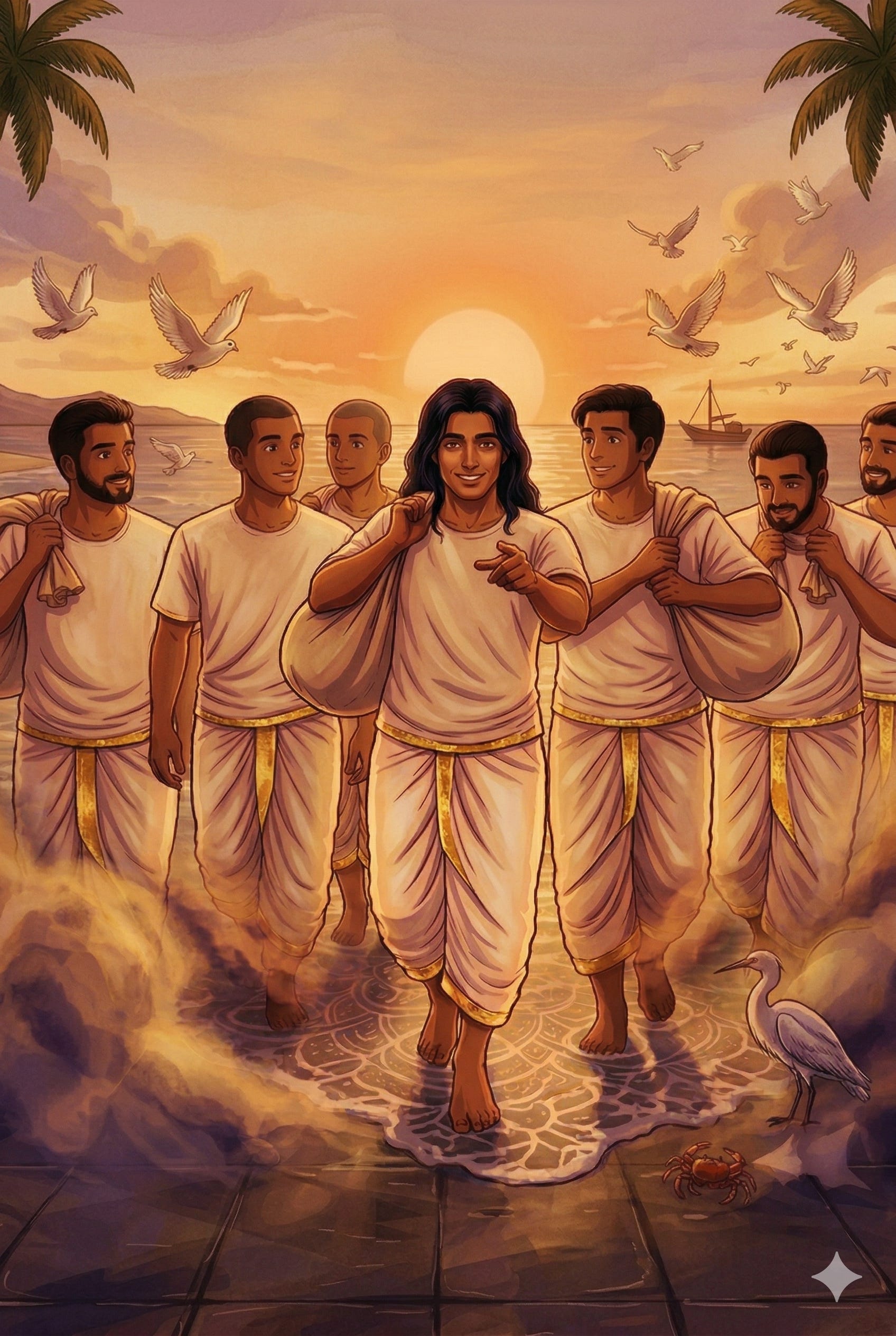
She told me she lived in a small house near the sea and went out every evening, even she did not know for what. One day, among many men dressed in white dhotis and white shirts, walking like seagulls, she saw him. Her new gandharvan. She saw him for many days, walking with men in white, and sometimes in costumes bright and ecstatic with colour. Sometimes he looked even more like the gandharvan she had dreamt of. And one day she decided to live with him.
My mind, when I heard her say that, was empty. I felt the vacancy inside me and even felt a stone there, one that could drop and never show me its edges or curves again. Like I feel now. The day fell like a leaf in autumn, and the next day I called her and asked her to come home and live here someday. I told her that I was leaving somewhere else in search of truth. She declined. I insisted again and again for days. So much so that I called her every minute and asked her and her new partner to come home. She agreed.
This was how I planned poetic justice for the life I had spent searching for truth. This was how the truth and love I had always searched for would answer me. The poetic fall of a search that had failed would end this way. In my death note, I would write all my love to her, ask her to live in this home with her partner, with all the love, and then I would end my life.
I spent another week writing the letter to her. I met my wife when she was seventeen and I was thirty. I was in Mumbai, and my life had different searches. I saw life stacked around corners and the city sorting people like piles of coins, and love like dark clouds and fog. My father asked me to marry and told me not to go back to Mumbai. He gave me ownership of a mill. There were lives I lived, people I met occasionally, and sometimes a whole life spent in search of my forever-search for truth in Mumbai, a place I had to leave without even saying goodbye to when my father picked me up and brought me home, telling me that the one answer to my search was my wife.
When I met my wife, she smelled of the champaca flower that bloomed in the courtyard of the house. Before I could even look into her eyes and lose all the answers and love she could offer me, she was already near me, already in my home. And that woman left one day. All in one day.
The letter had all the love that had churned through me over all those years and all that I had etched in my heart, telling myself: love without conditions. I had to write all of that in, with all the emptiness inside me. Maybe this was the answer to my search for truth after all. Not to feel, but to give without conditions. To feel all the emptiness inside, breath ebbing more than flowing. And to tell someone, “This is all I have for you… my love.”
I loved her more in that week than ever before. The day I knew she was with me and near me, I forgot the countless bodies and hands that had passed across my skin in my search, and believed she was the answer. I looked at her and smiled, and she smiled back in the first days of marriage. Every day my father made me take her to the movies. My wife would sweat on purpose in the theatre and always lean toward me to say something in every show. But she could not. I smiled back at her. My smile was an invitation for her to say something, even if it was hate.
It was one day after watching a Padmarajan movie, after seeing how a gandharvan made love to a girl on earth and returned home, that she told me — nervously, with hesitation — “You are like how I imagined a gandharvan would be. Your forehead in sweat is like the gandharvan’s in the movie.”
While writing the letter I cleaned the house. I planted chempakam trees there for her children to see. We never had children. I insisted not to have one while she wanted one. By the time she wanted one, I had outgrown her and the love I had for her. The moment I was ready to be loved and to know and feel love, my wife was searching for unearthly love, and it never felt like a moment. It felt like her smile and her care had conditions. She asked me to stay forever. I could not leave, but I felt I was not ready to stay forever with her, though she was ready to do the same with me. I could not leave, but I could not stay.
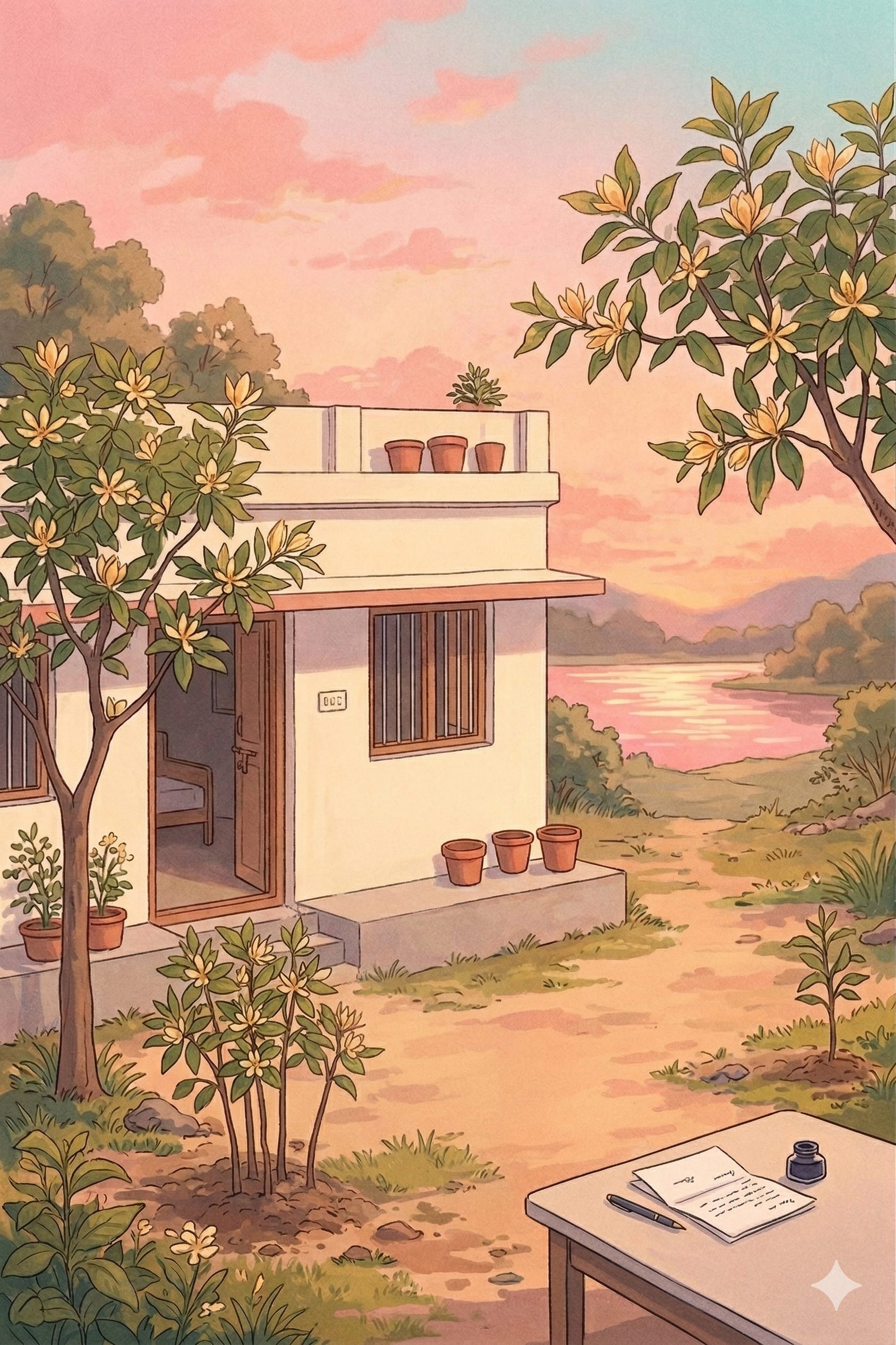
By the day the house was ready and the letter was ready, I texted my wife to come home anytime. The house had clean white sheets, tiles, agarbati drifting through the rooms the way she liked it. It was painted white again, the way she liked it. New glass utensils sat on the shelf, just as she had always wished. The books had been taken out. The rooms had small tables, white sheets, flowers on the table the way she liked. The almirah stood in the corner the way she liked. The walls had fewer murals, fewer paintings, plain and without pictures, the way she liked.
I took the smallest of the three rooms to live in for the last few days of my life. In the last years before leaving me, my wife had spent most of her days cleaning it and arranging everything. She kept my clothes in a case with soap covers and it smelled good when I took them out. And she had told me, many times, that when we had a child, this room could be theirs.
I was in search of love. Of truth. And in that search I went to too many places. I met people, spent days with them, sometimes closer to the skin. I hugged and cried with people for reasons that did not exist while my wife did not know where I was. It was during one of those searches that I became tired of people and their skin and brought home a stray. I believed the answer to my search for truth could be that stray. I named the stray Dream and spent days and nights with her. One day she came to me and I made stories in my head that told me there was some reason beyond life connecting the dog and me. My search could end with the dog. The love it gave me and the way it wanted to be with me could answer why truth was beyond the love I had yearned for and earned. Until one day my wife poisoned and killed it.
I knew she had killed it when I saw it die. I asked why. She could not answer. She said nothing, and so did I. For two years we did not speak in that house where it was only the two of us. Until one day she left.
I was wrong. This is the answer to my search. I would die today, by my own wish. And my wife would live in the design of my love. For the love I could not give her all these years, she would live on feeling many loves. I would fade away, the way I had wanted to for years.
I tied the rope to the fan and set the stool on the bed and reached up. The thought of everything stopped me, holding the rope for how long I do not know. I held it so tightly when the car honked and I heard it, and the stool slipped under my legs. My eyes shut into black.
In that blackout I was fourteen years old. I was in Bhopal, in the bed of my cousin. My cousin had a long beard and wore a hat then. He was over me. I was two people then — one who pushed him away from the sides, and the other who asked him:
“What truth is inside?”
“All truth, all love, like the love you felt when I touch you here.”
“What love then? What conditions?”
“All love that sheds conditions just lives inside you. And hugs you and sheds warmth over you, like I do.”
His body was cold. The hug was cold. How my body is cold today.
In the dark abyss of my closest death that day which told there is truth outbeyond what all I’ll ever see I could smell him and death together. But I had to wake up.
When I woke and realized I was sitting on a stool, I saw a man entering the room. It was my house that I had left for my wife. I could feel that she was inside the house, but instead of her the man came toward me.
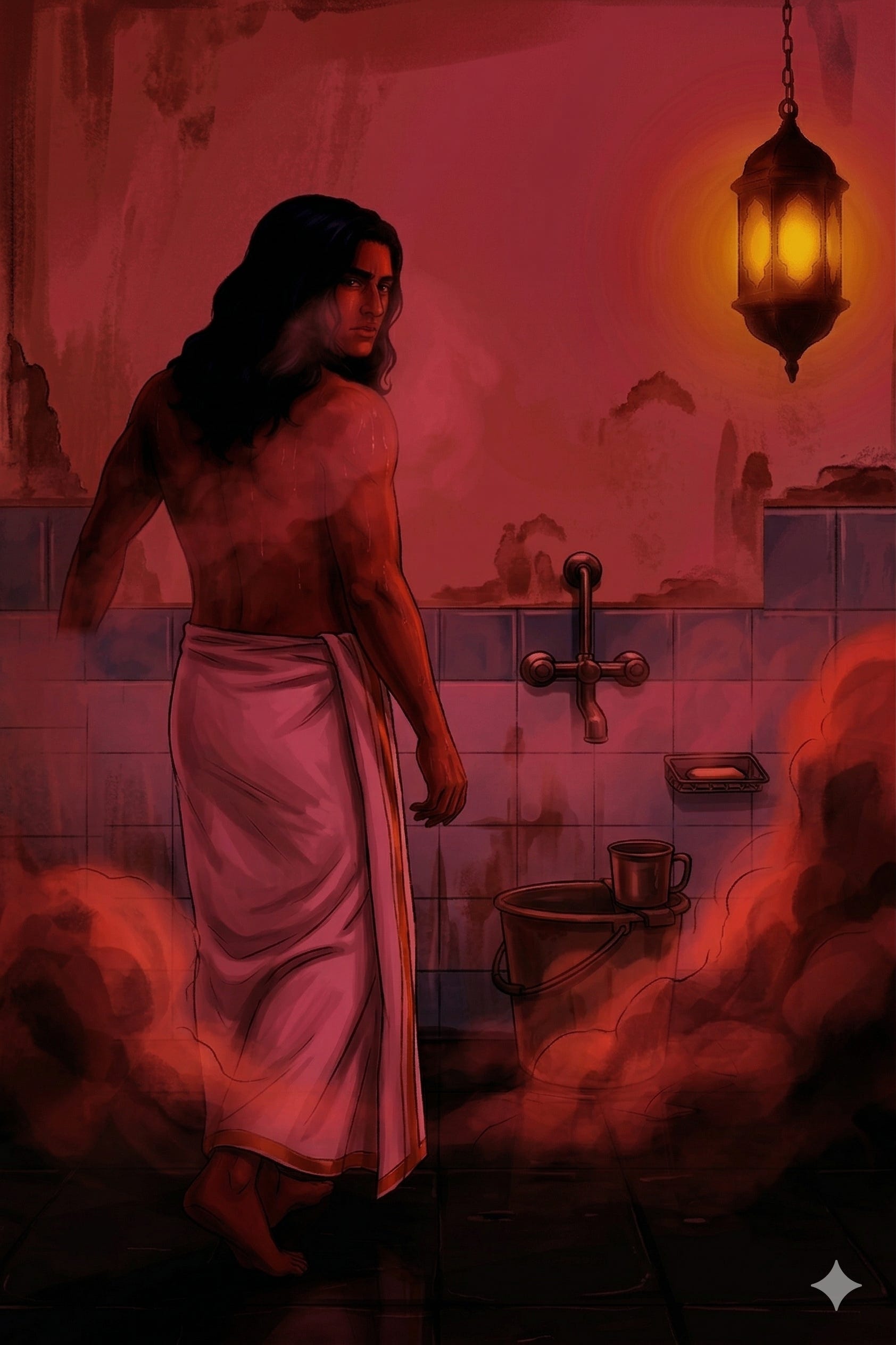
He smelled like my wife, and he was dressed in white. Steam rose from hot water and hid his face as he walked toward my body leaning against the wall. He came behind me and I could not move my head from the pain. He made me lean toward his body, his bare skin.

In that warmth I leaned into him while he poured water over me and scrubbed my body. He held my head in his arms and I rested there. And in that warmth I cried out to the world as he held me close, pulling me inward.
There were no answers left to search for now.